As we begin 2025, we reflect on a milestone that changed the course of technology forever: the Intel 8080, a microprocessor that turns 50 this year. Released in April 1974, it wasn't the first microprocessor, but it was the first general-purpose chip capable of operating independently, transforming the computing world as we know it.
The Birth of a Game-Changer
The Intel 8080 wasn’t born in isolation. It built upon the groundwork laid by earlier Intel chips, namely the 4004 and 8008, designed by the renowned Federico Faggin.
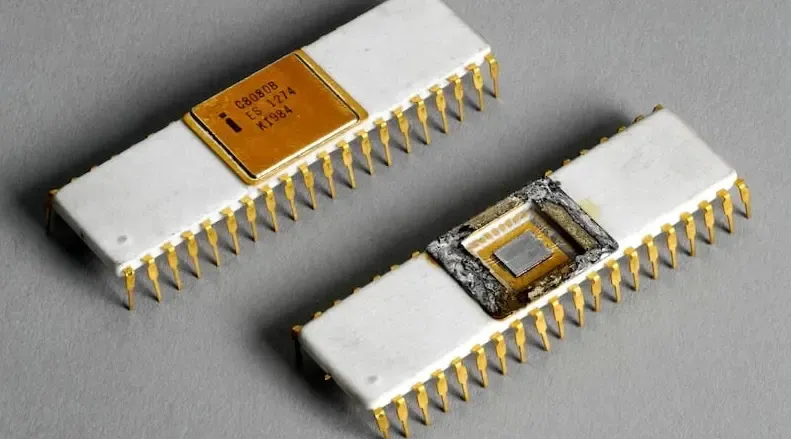
[Two Intel 8080 microprocessor chips, closed (left) and open (right). Image (modified) used courtesy of The Board of Trustees of the Science Museum UK]
Though these earlier processors were revolutionary at the time, they had limitations that hindered their broad applications. Intel’s mission was clear: develop a more capable, faster, and versatile processor that could break free of these constraints.
The result was the Intel 8080—a chip that would not only catalyze the microprocessor market but also secure Intel’s position as a world leader in semiconductor technology.
Why the 8080 Was Revolutionary
The Intel 8080 marked a huge leap forward in computing, offering:
-
Expanded Address Space: The 8080 could access up to 64 KB of memory, compared to the 8008’s modest 16 KB.
-
Increased Clock Speed: Operating at 2 MHz—later variants clocked up to 3.125 MHz—this processor was far faster than its predecessors.
-
Richer Instruction Set: With more than 70 instructions, it became far easier to write software for this chip.
-
Better Input/Output Capabilities: The 8080 was designed for versatility, making it ideal for a wide range of applications from personal computing to industrial systems.
Frederico Faggin, who played a key role in its development, remarked, “The 8080 made it real"—it was the first true “computer on a chip.”
A Giant for Its Time
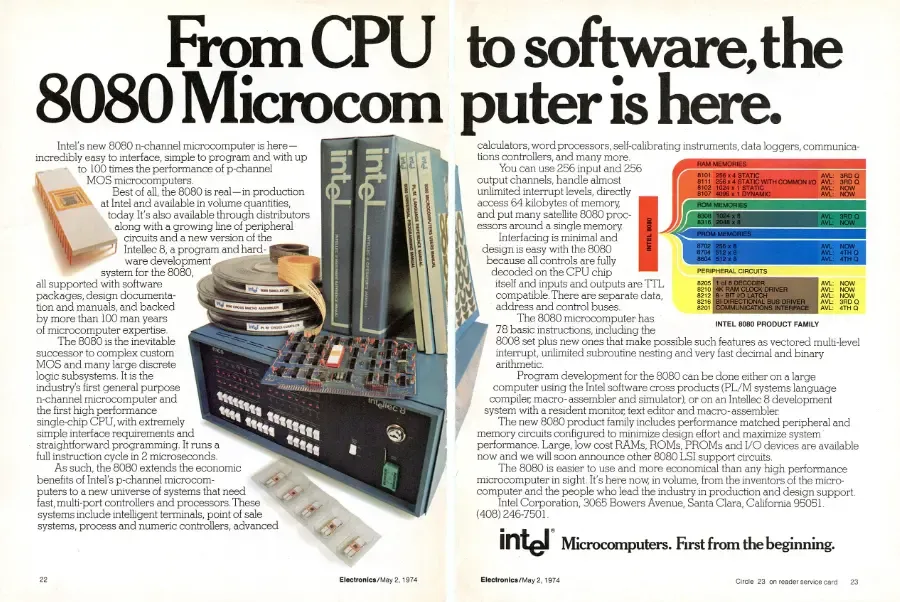
[Advertisement for the chip from May 1974]
In its day, the Intel 8080 was a true powerhouse in microprocessor design. Its features included:
- 8-bit Processor with a 16-bit address bus
- Clock Speed of 2 MHz, with variants that reached up to 3.125 MHz
- 6,000 Transistors built on six-micron process technology
- 40-Pin Dual In-Line Package (DIP) for better connectivity and interfacing with support chips
While these specs may seem modest by today's standards, they were a monumental leap forward in 1974.
Impact Beyond the Chip
The 8080’s influence reached far beyond just technical specs. Its release marked a turning point in computing history, powering innovations that would shape industries for decades.
The Altair 8800: One of the first personal computers, the Altair 8800 was powered by the 8080. Its success sparked the development of the BASIC interpreter by Bill Gates and Paul Allen, eventually leading to the founding of Microsoft.
-
The Video Game Revolution: The 8080 was also used in classic arcade games like Space Invaders, helping fuel the video game industry’s growth.
-
Embedded Systems: Its versatility made it ideal for embedded applications, controlling everything from industrial equipment to medical devices.
-
Operating Systems: The 8080 played a crucial role in the development of early operating systems, including CP/M, which directly influenced MS-DOS, the foundation of Microsoft's dominance in the personal computer market.
A Lasting Legacy
Fifty years later, the Intel 8080 remains a powerful symbol of technological innovation. It helped ignite the microcomputer revolution, advanced software development, and proved that microprocessors could be at the heart of fully functional computing systems.
Though modern processors are vastly more powerful, the legacy of the 8080 is still evident. It was more than just a microchip—it was the spark that set the digital age in motion.
Today, as we marvel at the billions of transistors in our smartphones and computers, we owe a debt of gratitude to the Intel 8080, which set everything in motion.